Kim et al. published a study in Nature studying the effects that different running shoes (technologically advanced running shoes TARS, Conventional running shoes CON, and minimalist shoes MIN) have on running biomechanics. Respectively, the three shoes they used were: Nike air zoom alpha-fly next %, Addidas ultra boost 20, and asics sortiemagic RP5.
How did they do it
Then, participants completed six 7-minute sub-maximal steady state runs, with two runs under each shoe condition. That means two 7-minute runs with each of the three shoe conditions: 2xTARS, 2xCON, and 2xMIN. The order was randomized. Each 7-minute run was composed of a 1-min run at 70%, 1-min run at 80%, and a 5-min run at 90% of each runner’s respective ventilation threshold speed.
What they found
Runners strike the ground in one of three ways: hindfoot (heelstrike), midfoot, and forefoot. Research has implicated that a habitual heel strike pattern can increase the risk of running related injury (RRI). Midfoot and forefoot strikers appear to have an attenuated RRI risk. The researchers from this study found that foot strike angle (lower angle = less heel strike) was significantly lower from TARS than from CON. Also, TARS were found to be more effective than MIN in reducing FSA and consequently inducing a forefoot strike (FFS) or midfoot strike (MFS) pattern.
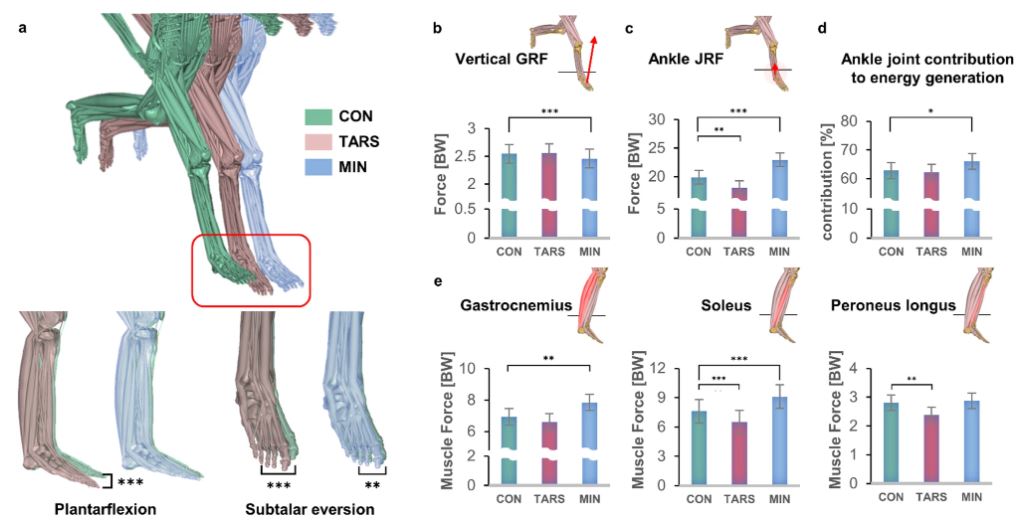
They also found that TARS significantly increased ankle plantarflexion angle and subtalar eversion angles at initial contact (when the foot first strikes the ground) compared with CON. The next phase of gait after initial contact is loading response. Here they found that TARS significantly increased ankle plantarflexion ankle and decreased subtalar eversion angle.
They found that MIN reduced the peak vertical ground reaction force vector (GRFV – the force of the ground into you) compared with CON. MIN lead to significant increases in peak gastrocnemius and peak soleus forces compared with CON, whereas TARS significantly reduce the peak soleus and peak peroneus longus forces.
Additionally, they found that MIN significantly increased the ankle joint’s contribution to energy generation compared with CON, where TARS do not. TARS do not increase the demands on the knee or hip either.
The take-home message
This research demonstrates that TARS induced FFS and MFS patterns along with increased ankle plantarflexion angle and subtalar eversion angle at initial contact. TARS were also found to decrease the subtalar eversion angle at loading response. Research has suggested that excessive subtalar eversion during the loading response can increase the risk of injury, including medial tibial stress syndrome (shin splints). TARS were found to reduce ankle joint reaction forces and muscle forces in the soleus and peroneus longus during stance. The biomechanical changes found suggest that TARS alter mechanical loading in ways that may reduce the risk of achilles tendinopathy and metatarsal stress fractures.
Kim, H., Ahn, J. Technologically advanced running shoes reduce biomechanical factors of running related injury risk. Sci Rep 15, 17828 (2025). https://doi.org/10.1038/s41598-025-03029-0